
Publication
3D Visualization for Vileda: When Even a Cleaning Cloth Matters
Task
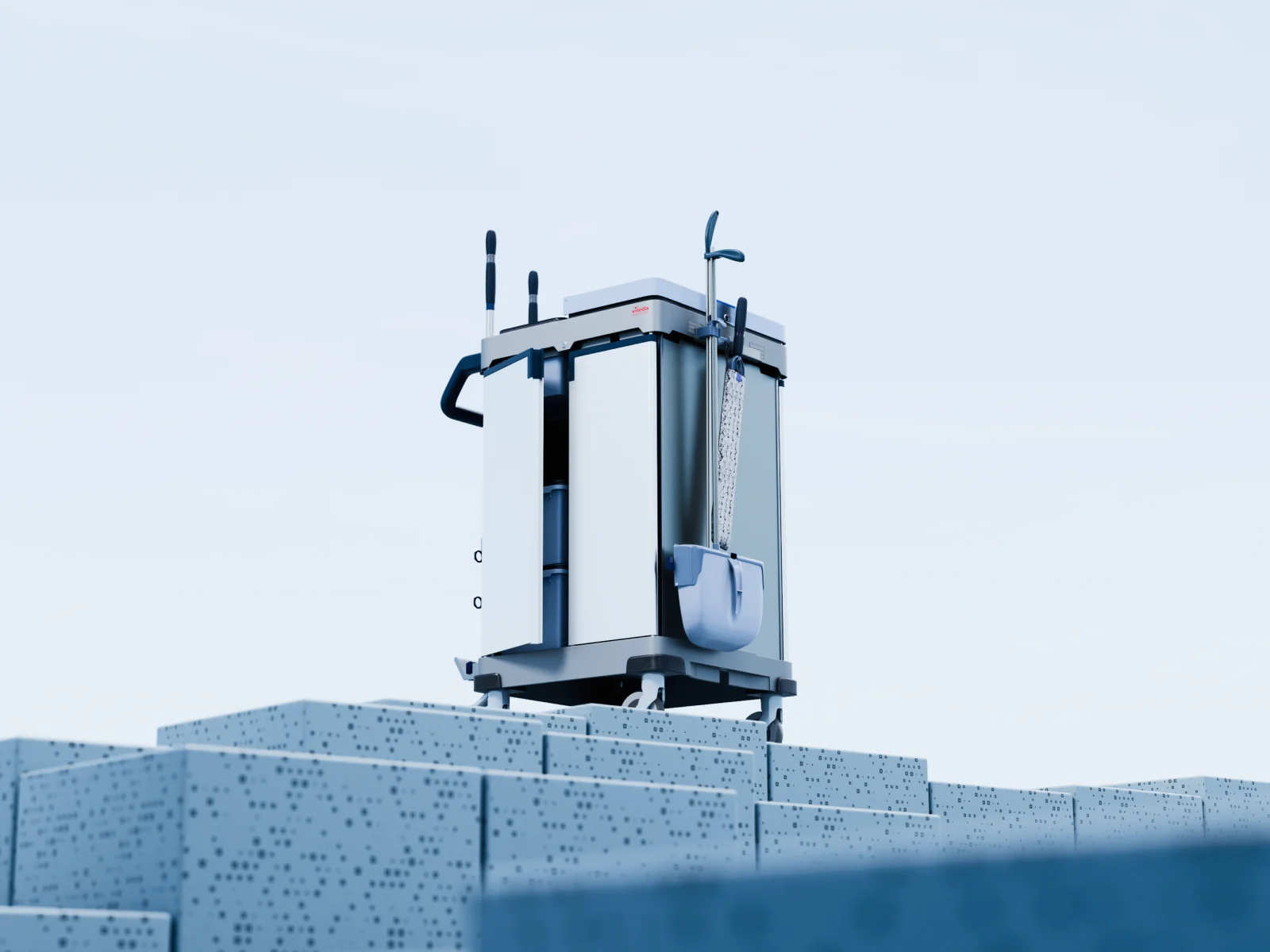
Our goal was to convey the premium quality and the logic behind using Vileda’s cleaning equipment through 3D graphics. It wasn’t enough to simply recreate the objects — we needed to show how a user interacts with them, how each component works, and what makes the product stand out compared to competitors. The visualization had to accomplish several things at once: be technically accurate, aesthetically refined, and commercially effective.
We quickly realized that geometry alone wouldn’t be sufficient. Without precise material representation, realistic usage scenarios, and the right spatial atmosphere, the final result would fall short. That’s why the core of the project became a cohesive visual narrative — from form to function.
What We Did
Modeling From Scratch
We began by building accurate geometry for more than ten objects — from cloths and mop heads to carts, handles, and attachments. Every model was created manually, without technical drawings, relying solely on reference photos provided by the client.
To achieve clean, smooth forms, we used subdivision surface modeling.
A unified bounding container was established to maintain consistent scale across all assets.
We also created custom controllers for every animated component — swivel wheels, lids, handles, and folding mechanisms.
Controllers are created for all animated parts: swivel wheels, lids, handles, folding parts.
Key Features
The cloth was animated step by step using rigging, bones, and lattice deformation to achieve a precise and realistic folding effect.
The mop head was given fibers of varying lengths and a naturally chaotic structure. We tested several approaches before settling on an optimal solution based on lightweight deformers.
Additional elements — such as bags, covers, and attachments — were created using sculpting and displacement techniques to achieve authentic folds and surface detail.
As a result, the models not only look visually refined but also behave correctly in animation and interactive scenarios. This accuracy is essential for demonstrating real product functionality.
Working With Textures and Lighting
We used a combination of studio and interior HDRI lighting to create a clean, hygienic visual atmosphere. The light was slightly cool in tone — a shade often associated with medical precision — helping to emphasize the purity and crispness of the materials.
We developed several procedural materials, including matte and glossy plastics, metals, and rubberized surfaces.
For the cloths and mop heads, we used custom texture maps: high-resolution photos were refined manually to produce height, roughness, and ambient occlusion maps.
The wheels were given a unique wear and contact mask, with detail down to subtle micro-scratches along the edges.
We’re not just showing an object — we’re conveying a sense of tactility.
The material is something you can almost feel with your eyes, which strengthens both the credibility and perceived quality of the product.
Animation in Action
To demonstrate how the product functions, we created several animation sequences:
Figure-eight cleaning motion: Using the client’s video reference, we recreated a realistic trajectory of the mop’s movement. It was crucial to accurately convey the uniqueness of the patented cleaning technique.
Mop folding: Implemented along a precise motion curve — a clean, step-by-step sequence that remains instantly recognizable.
Fiber contact with uneven surfaces: The fibers dynamically follow the surface geometry thanks to an adjusted anchor point and a driver-based system, effectively simulating how the mop “collects” debris.
Each scene was optimized for export as PNG sequences or video clips, making them suitable for landing pages, social media, and other digital formats. These animations allow the product to be explained both clearly and concisely — without unnecessary commentary.
Visual scenes
For the background-integration shots, we reconstructed the room’s geometry based on a single photograph, matched the lighting, and then hid everything except the shadows and the main object. This allowed us to place the 3D model into a real environment with complete accuracy in terms of perspective and illumination.
We used transparent shadows and an environment setup with no visible geometry.
The camera was matched to the focal length of the original photo.
This technique makes it possible to seamlessly integrate a 3D object into virtually any environment without additional post-production.
Assembly and Presentation
The final material was assembled in After Effects.
We added smooth zoom transitions and pop-up callouts highlighting key elements.
The content was adapted both for vertical scrolling (landing pages) and for slide-based formats used in presentations.
The client also received all assets as PNG sequences with alpha channels, as well as MP4 files ready for use on websites, marketplaces, and social media platforms.
What the Client Received
Photorealistic 3D visualization that highlights the product’s unique features and reinforces the brand’s premium quality.
A set of animations that clearly explain the mechanics of use — suitable for both B2B presentations and end-user communication.
Flexible content that can be scaled, repurposed, and adapted across various platforms and media.
Optimized scenes that render efficiently, saving time and budget for future projects.
“We didn’t just create 3D — we visualized value.”
The project was also well received by the professional community and was selected for the Behance 3D Gallery, underscoring its quality and relevance.
Why Does a Company Need This Kind of Visualization?
Why create detailed 3D renderings for mops and cloths?
Because it’s these “small” details that reflect the true level of the brand. This isn’t just functional equipment — it’s part of a professional, well-designed cleaning system. And that deserves to be shown properly.
Why not just use photographs?
Photos don’t convey interaction.
They don’t show movement, dynamics, or mechanics.
Which means they can’t teach, persuade, or sell — at least not effectively.
Why not rely on video?
Video is limited by real-world constraints:
camera angle, speed, lighting, environment, and the inability to show internal mechanisms or micro-details.
Unlike 3D, it doesn’t allow you to freely change angles, scale, timing, or reveal hidden components — such as fiber structure, correct folding sequences, or patented motion logic.
3D graphics provide complete control over the process, ensure consistency, and significantly reduce production costs when updates or variations are needed.
Where This Is Used
- Websites and landing pages
- Presentations for retail and B2B partners
- Training materials and e-learning
- Video reviews, YouTube, and social media
- Interactive 3D experiences (for example, via WebGL)
Want the Same Quality?
Send us a request, and we’ll visualize your product with the same level of attention to detail — original, template-free, and with a genuine understanding of how it’s meant to work.
.png&w=3850&q=85)